Full Treatment In Your Home
£189
Normal price £285
- 1 x Pre-consultation in your home
- 1 x Laser teeth whitening treatment
- 1 x Aftercare

Treatment Packages
Choose the treatment package that suits you. Every offer includes the consultation, laser teeth whitening treatment and aftercare, with no hidden charges.
£189
Normal price £285
£350
Normal price £570
£139
Normal price £209
Prices shown are August 2026 promotional offers. The advertised price includes everything listed above.
Book Your AppointmentMost people arrive at a page like this looking for a single number, glance at it, and leave. That is an understandable habit and a poor way to choose a treatment, because the number on its own tells you almost nothing about what you are getting. Two packages can carry similar figures and contain quite different things.
So this page concentrates on content rather than cost. The offers here run as monthly promotions, which means the figure attached to any package reflects whatever is running at the time and moves through the year. A number published here today would be quietly wrong by the time some of you read it, and a stale figure is worse than no figure at all. What does not change month to month is what each package actually contains and that is the part worth understanding before you enquire. Confirm the current figure at the point of enquiry, before you commit to anything.
If you are looking specifically for local information, you can also review the current Laser Teeth Whitening Prices available in Leicester before making your decision.
One thing is worth stating early, because it shapes how you should read everything below. The pricing is intended to be inclusive. The advertised figure covers the package as a whole rather than acting as a headline rate with extras added afterwards; there are no hidden charges; and the charging process is deliberately kept simple. Major credit cards are accepted. If you are ever quoted something on top of the advertised figure, ask what it is for and what it covers before you agree to it.
Booking works through a written enquiry rather than an instant online booking. You describe what you are after, someone reads it and comes back to you, and the appointment is arranged between you from there. That extra step is not friction for its own sake — it is the point at which suitability gets discussed, which matters more with whitening than it does with most things you can buy in a single click.
Each package is built from the same three parts. Knowing what those parts are makes the differences between the packages much easier to read, and it means the descriptions further down this page do not have to keep re-explaining the same ground.
Every package includes a pre-consultation, and it is not a formality to be rushed through. This is where your teeth are looked at properly rather than described over a form: the existing shade is assessed, the type of discolouration is considered, and any restorations, sensitivity or dental history that might affect the approach are discussed. It is also the point at which you should expect to be told if whitening is not the right idea for you at the moment.
Treat it as a two-way conversation rather than an inspection. It is your opportunity to ask what a realistic change looks like for teeth like yours, to raise anything you have been unsure about, and to say plainly what you are hoping for. A pre-consultation that surfaces a mismatch between expectation and reality has done its job, even if the answer you get is not the one you wanted.
The treatment itself is a single appointment built around roughly an hour of chair time. The gums and soft tissue are isolated and protected first, a professional whitening gel is applied to the teeth, and a light source is used to activate it across one or more cycles. You are awake, seated and comfortable throughout; there is no drilling and no anaesthetic involved.
It is worth being clear about what the treatment is and is not. Whitening lifts discolouration from within the natural tooth. It is a cosmetic process, not a restorative one, and it does not clean, repair or treat anything. It is not a substitute for seeing a dentist and it does not address any underlying problem.
Aftercare is included in every package and is the part most often ignored, which is a shame, because it has more influence over what you are left with than almost anything else. The hours immediately after treatment are when teeth are most receptive to picking up colour again, and what you eat and drink in that window matters disproportionately.
Aftercare guidance typically covers which foods and drinks to avoid in the short term, how to manage any transient sensitivity, and the day-to-day habits that determine how long you hold on to the change. None of it is complicated. It does require you to actually follow it for a period, which is worth knowing before you book something the day before a holiday built around red wine.
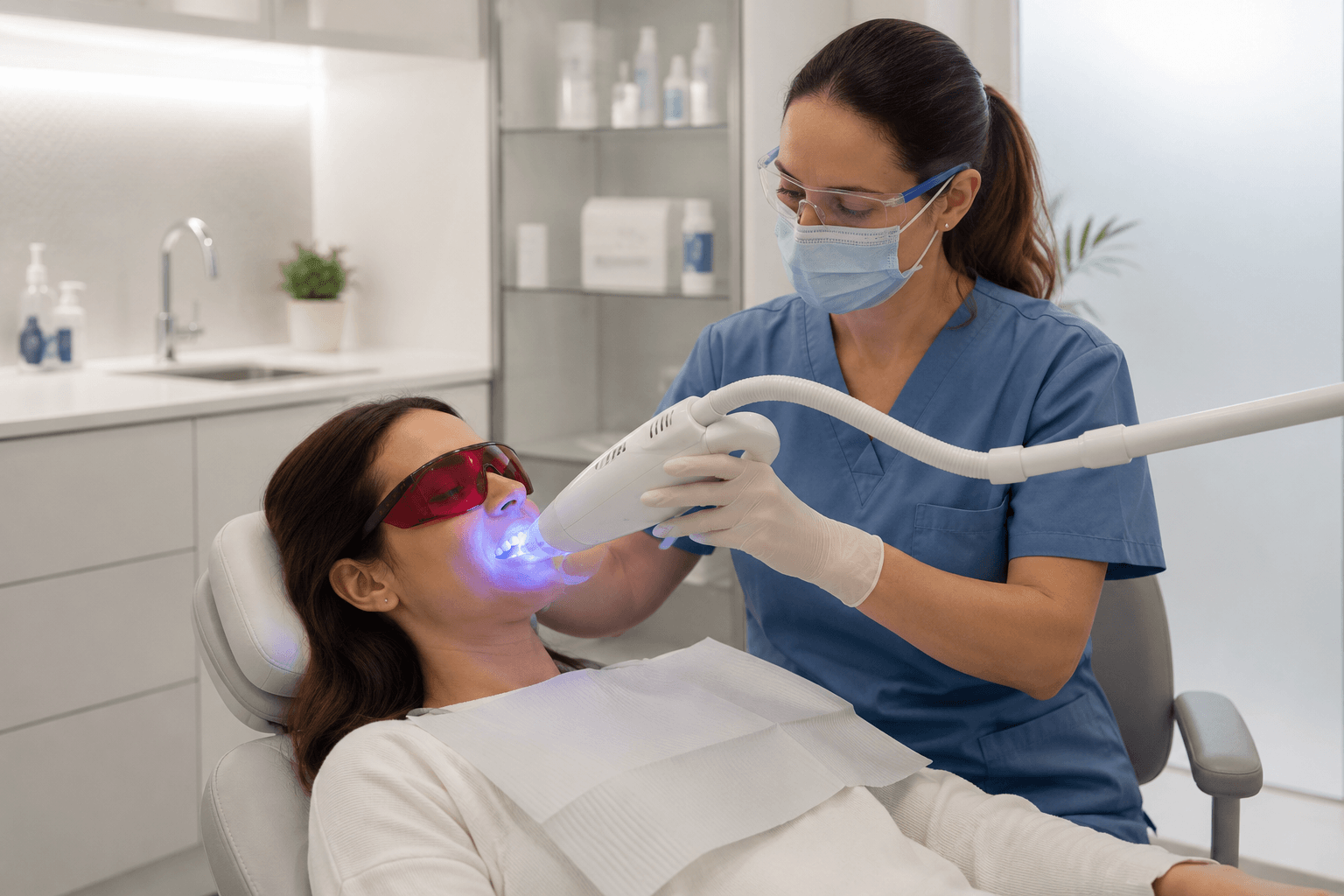
This is the standard single-person package, and it is the one most first-time clients take. Everything happens at your address: the pre-consultation is carried out in your home, the laser whitening treatment follows, and the aftercare guidance is provided as part of the same package. There is no clinic to travel to and no waiting room to sit in.
It suits anyone having professional whitening for the first time, because the pre-consultation and the treatment sit together in one visit and you can ask questions in an environment where you are relaxed rather than in a clinical setting. That matters more than it sounds for people who find dental environments uncomfortable — and there are a great many of them, including plenty who have avoided cosmetic treatment entirely for that reason.
It also suits anyone for whom travelling is the actual obstacle. If you do not drive, if public transport to a clinic is awkward, if you have small children whose logistics collapse the moment you leave the house, or if a mobility issue makes an unfamiliar building a genuine barrier, having the appointment come to you removes the problem rather than working around it.
Because the appointment is at your address, the time cost is close to the appointment itself. There is no journey either side, no parking, and no waiting beyond the arranged time. In practice this fits into a working day more easily than a clinic appointment of the same length, particularly if you work from home or can arrange an evening slot.
What you should plan for is the aftercare window rather than the appointment. Give yourself a settled evening afterwards where you are not committed to a meal out or an event, and think about where the appointment sits relative to anything you are preparing for. Sensible spacing before a wedding, a milestone birthday or a set of photographs gives you room to see how your teeth have responded rather than finding out on the day.
Practically, you will need somewhere to sit comfortably with reasonable light and access to a power socket. Nothing elaborate — a kitchen or living room works — but it is worth thinking about in advance rather than clearing a space while somebody waits.
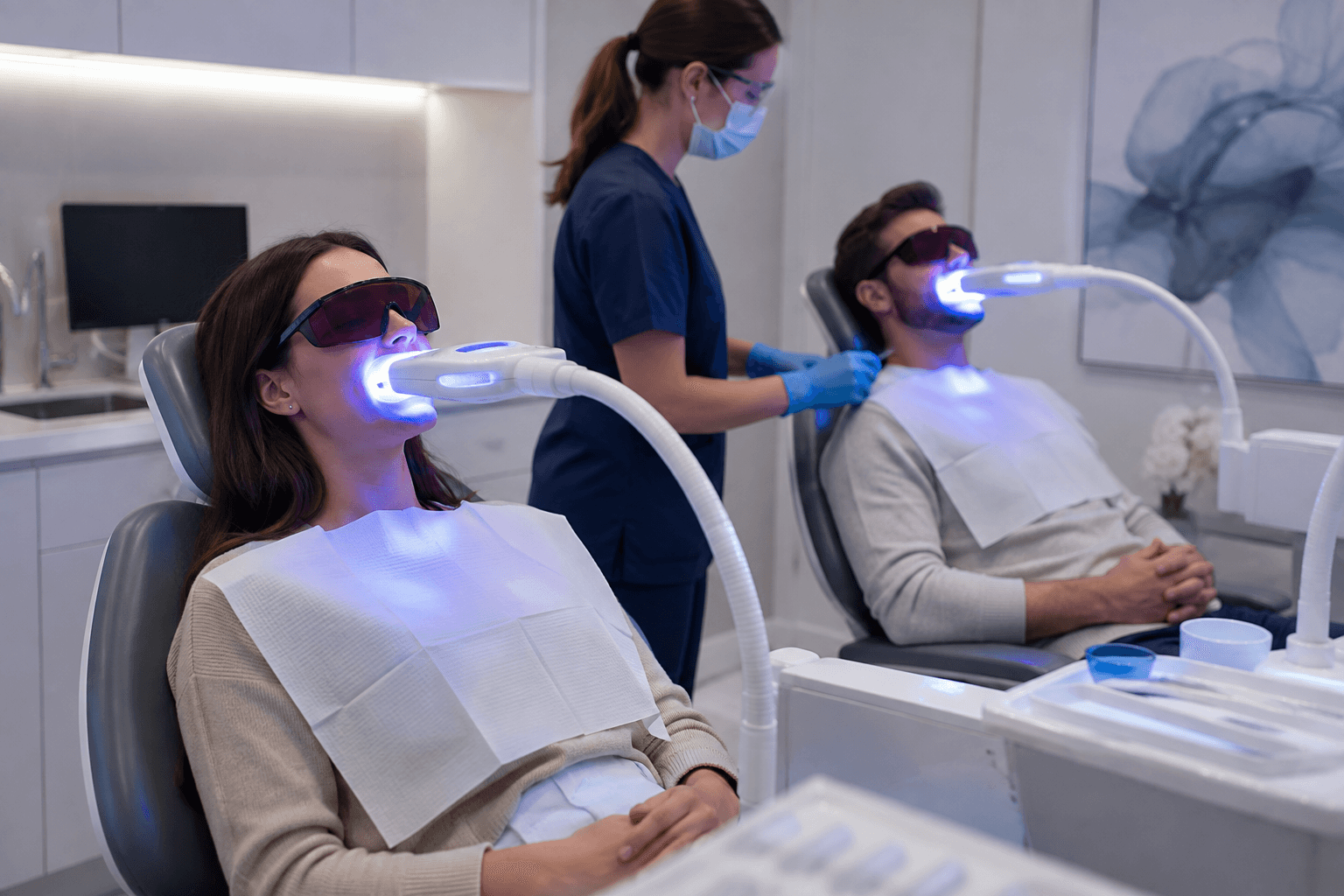
The two-person package covers two people in one visit. Each person receives their own pre-consultation in the home and their own laser whitening treatment; the aftercare is provided once, as a single full set covering both.
This is the detail worth understanding, because it is the thing people assume gets shortened when two treatments are combined. It does not. Two people booking together still receive two individual pre-consultations, and that is deliberate rather than generous.
Two people living in the same house can have entirely different mouths. One may have a crown at the front and the other none; one may have had whitening before and the other never; one may have sensitive teeth and the other no history of it at all. A shared assessment would flatten those differences into an average that fits neither person. Being assessed separately is what allows each of you to be told something true about your own teeth — including, if it applies, that whitening is not the right step for one of you even though it is for the other.
The aftercare is the part that is genuinely shared, and sensibly so. The guidance itself is the same information regardless of who receives it, and two people in one household following the same regime at the same time is easier than one person doing it alone.
The obvious case is couples, and the most common reason is a shared event — a wedding where both of you are in the photographs, an anniversary, a christening, a family gathering that has been in the calendar for a year. Booking together means both of you are treated at the same point relative to the date, which is more sensible than one of you going ahead and the other catching up a fortnight later.
It also suits friends, siblings, housemates, a parent and an adult child, or two people in a wedding party who would otherwise each arrange something separately. There is no requirement that the two people are related or live together — only that both are at the same address for the visit.
A two-person visit takes longer than a single one, so treat it as an evening or a substantial part of an afternoon rather than something to squeeze between commitments. Both people need to be present and available for the whole visit rather than one arriving partway through.
The practical advantage lands afterwards. Aftercare is considerably easier to follow when the person you eat with is following it too, and the first evening in particular is far simpler when nobody is opening a bottle of red or making coffee. Two people committing to the same short window tend to hold to it; one person doing it alone in a household that is not tends not to.
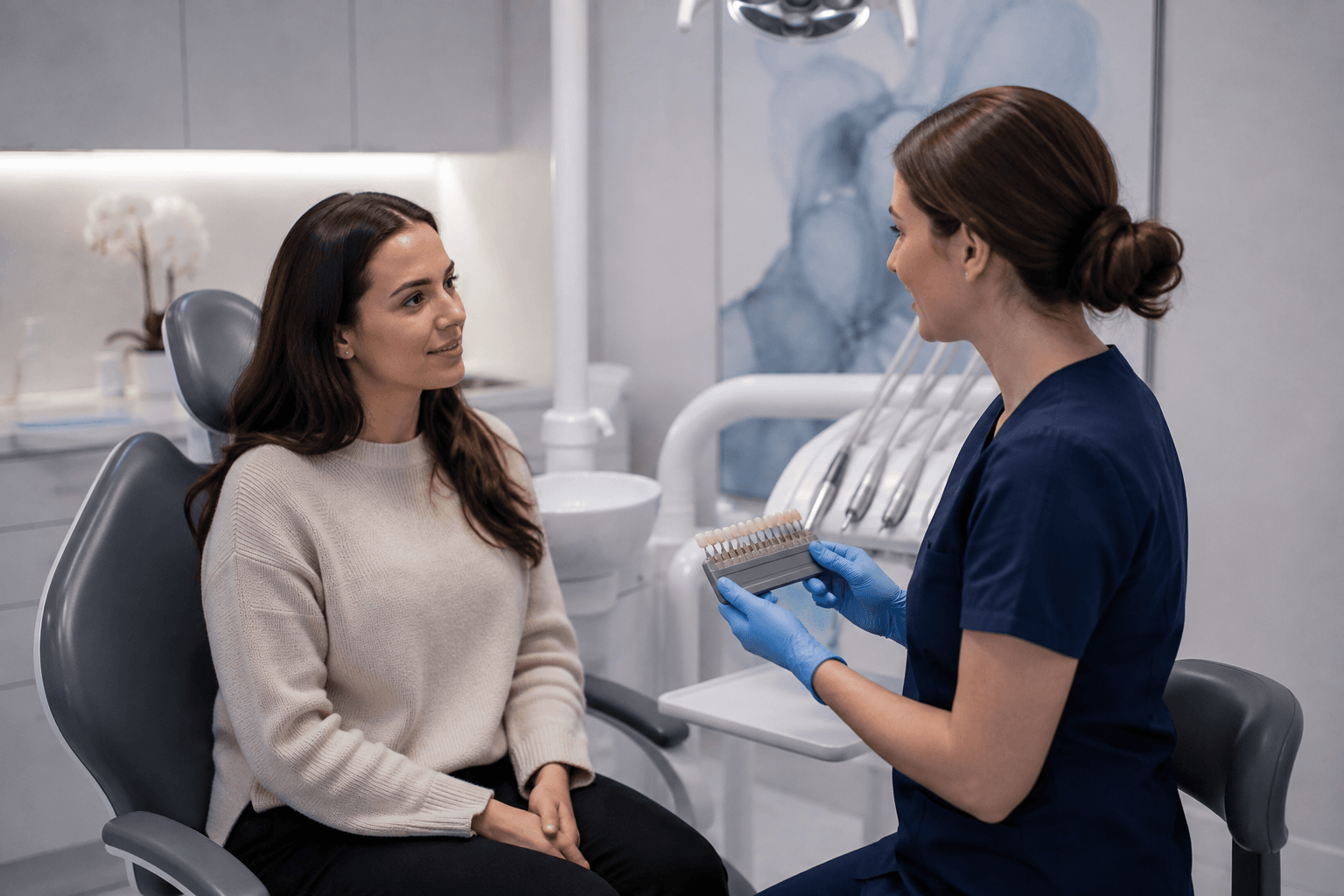
The refresh package is for people who have been treated before and want to bring their teeth back towards where they were. It is not the same shape as the two packages above: the pre-consultation takes place at a local centre rather than in your home, and it is available to returning customers rather than to first-time clients.
This is the structural difference between the refresh package and the other two, and it is worth reading properly before you choose it, because it changes what your day looks like.
A returning client is a different proposition from a new one. There is already a record of how your teeth responded, what shade you started from, what was used and whether you experienced any sensitivity. A refresh assessment is largely a comparison against that history rather than a full first assessment from nothing, and it is a shorter conversation as a result. Holding it at a local centre reflects that.
What it means for you is straightforward but easy to miss: this package involves travelling to a centre for the consultation stage, where the other two do not. If the reason a home visit appealed to you in the first place was that travelling is difficult, that consideration has not gone away simply because you are a returning client. Ask what your options are when you enquire rather than assuming the refresh package is automatically the right one just because you have been treated before.
It suits anyone who has been through a full treatment previously and has since seen their teeth drift back — usually gradually, usually through ordinary habits rather than neglect. Tea, coffee, red wine and smoking are the familiar contributors, and their effect is cumulative rather than sudden. Most people notice it in a photograph rather than in the mirror, because daily change is too slow to register when you see it every morning.
It also suits people who have decided to keep whitening as a periodic thing rather than a one-off, and who want the assessment step kept proportionate to what is actually needed.
Plan for two separate commitments rather than one: the consultation at the centre, and the treatment itself. Ask how the two are scheduled relative to each other when you enquire, since that determines whether this is one afternoon or two separate trips out.
The aftercare window is no shorter for a refresh than it is for a first treatment. It is tempting to treat a repeat visit as routine and skip the part you have heard before, and that is precisely how people end up disappointed with a result that would otherwise have held. The guidance applies in full every time.
For most people this is a shorter decision than it first appears, because the packages are not really competing with each other. They answer different questions.
Start with whether you have been treated before. If you have not, the refresh package is not open to you and the choice is between the single and two-person versions of the same thing. If you have been treated before, the refresh package exists for exactly that situation — but check how the local-centre consultation fits your circumstances rather than assuming it suits you by default.
Then ask how many people are actually being treated. This sounds obvious and is the point at which people most often get it wrong in both directions. Booking a two-person package on the assumption that a partner will probably join in is how one of you ends up paying for something nobody used. Equally, two people booking separately when both intend to go ahead is more organising than it needs to be. Decide properly first, then enquire.
Finally, think about the shape of your day rather than only the treatment. Whether travelling is easy or difficult, whether an evening is more realistic than a weekday, whether there is a date you are working towards — these tend to decide the matter more than any feature comparison does.
If you are based in Portsmouth, it may also be useful to compare the local LA Teeth Whitening Prices before deciding which treatment arrangement is most suitable for you.
If it is still not obvious, say so when you enquire and describe your situation rather than naming a package. Being told which one fits is a better outcome than choosing the wrong one confidently. The contact page covers what to include so the answer you get back is a useful one, and the results page is worth looking at first if you want to calibrate what a realistic change looks like before you commit.
The pre-consultation is included in every package and is the only point at which anyone can say something specific about your teeth. It is also, for most people, the moment they forget every question they had been meaning to ask. A few worth having ready:
What is causing the discolouration on my teeth? Not all staining behaves the same way. Surface staining accumulated from tea, coffee, red wine or tobacco responds differently from discolouration that comes from within the tooth, and the answer shapes what is realistic for you. It is a fair question and it should get a specific answer rather than a general one.
What sort of change is realistic for teeth like mine? Ask for an honest assessment rather than an encouraging one, and be wary if the answer is a confident promise. Nobody can guarantee an outcome in advance, and the useful reply describes a range and the things that will influence where you land in it.
How will my crowns, veneers, bonding or fillings look afterwards? If you have restorations anywhere near the front of your mouth, this is the single most important question on the list, because whitening will change how well they match and that change is not reversible by whitening more.
Is there any reason I should see a dentist first? Ask it directly and take the answer seriously if it is yes. A pre-consultation that sends you to a dentist has done its job properly.
What should I expect in the first day or two? Cover sensitivity, what to avoid, and how long the aftercare window runs, so you can plan the days around the appointment rather than discovering the constraints afterwards.
If you get an answer you do not follow, say so and ask again. There is no benefit to nodding through an explanation you did not understand, and a straight question deserves a straight response.
“No hidden charges” is a phrase used by almost everybody, which makes it close to meaningless unless somebody says what it actually covers. Here it means the advertised figure is for the whole package — the pre-consultation, the treatment and the aftercare together — rather than a headline rate that grows once you are committed.
The practical test is simple. You should be able to hear one figure at the point of enquiry, agree it, and pay that figure at the end without a second conversation about extras. If something additional is ever mentioned, ask what it is for, what it includes, and whether it is optional, before you agree to it. That is a reasonable question and you should expect a clear answer to it.
Payment is by major credit card, and the charging process is intentionally kept simple rather than split into stages that are difficult to follow. As with any service arranged in your home, confirm what has been agreed in writing through the enquiry thread before the appointment, so that both sides are working from the same understanding of what was arranged.
Because the offers run monthly, it is also worth confirming that whatever you were quoted still applies at the time of your appointment if there has been a gap between enquiring and booking. Asking is quicker than assuming.
Whitening is a cosmetic treatment. Used sensibly, it is a straightforward thing that many people are pleased with; used as a substitute for something else, it disappoints. A few principles are worth holding onto whichever package you choose.
More is not better. Whitening is not a treatment that improves with repetition, and there is nothing to be gained by returning sooner than advised in the hope of going further. If you find yourself thinking about your teeth constantly and planning the next round while the last one is barely finished, that is worth pausing on. The point of the treatment is to stop thinking about it.
It does not replace dental care. Whitening changes the colour of natural teeth and does nothing else. It does not clean them, does not treat decay or gum problems, and does not compensate for a check-up you have been putting off. If something is wrong, whitening is not the answer and will not disguise the problem for long.
Aftercare is the half people skip. Almost every disappointing outcome has aftercare somewhere in the story. The guidance is short and it works, but only if you actually follow it for the period you are asked to rather than the first afternoon.
Set expectations from real results, not from screens. Photographs online are lit, edited and selected. If you want a grounded sense of what whitening looks like, look at the results page and at people you know, and treat anything that looks luminous as what it is.
Timing beats intensity. If you are working towards an event, arrange treatment with enough room to see how your teeth respond and let any transient sensitivity settle. Booking as late as possible in the hope of maximum effect on the day is the single most common planning mistake.
Everything on this page describes what each package contains. It is general information about the treatments offered and is not dental, medical or individual advice, and nothing here should be read as confirmation that whitening is appropriate for you.
Suitability is established individually at the pre-consultation and cannot be determined from a web page. Whitening is not suitable for everyone. It is not suitable during pregnancy or while breastfeeding. If you have untreated decay, active gum disease, or any dental pain, speak to a dentist before arranging cosmetic treatment; the same applies if you have had dental work recently, where the view of whoever carried it out is the one that matters.
Whitening does not change the colour of crowns, veneers, bonding or fillings. Where restorations sit towards the front of the mouth, whitening the natural teeth around them will alter how closely they match, and that is worth discussing before treatment rather than after it.
Results vary between individuals. No specific shade change, and no particular length of time that a result will hold, can be promised in advance — both depend on your starting point, the nature of the discolouration and your habits afterwards. Some people experience temporary sensitivity following treatment. Any questions about your own circumstances should be raised at the pre-consultation, where they can be answered against your actual teeth rather than in general terms.